Vintage Computer Festival Pacific Northwest
vcfpnw.org
Tukwila Community Center, Tukwila, WA 98168
Sponsored by the Interim Computer Museum (icm.museum)
Vintage Computer Festival Pacific Northwest
vcfpnw.org
All presentations will be on Saturday, May 2nd in Meeting Room B, right next to the main event.
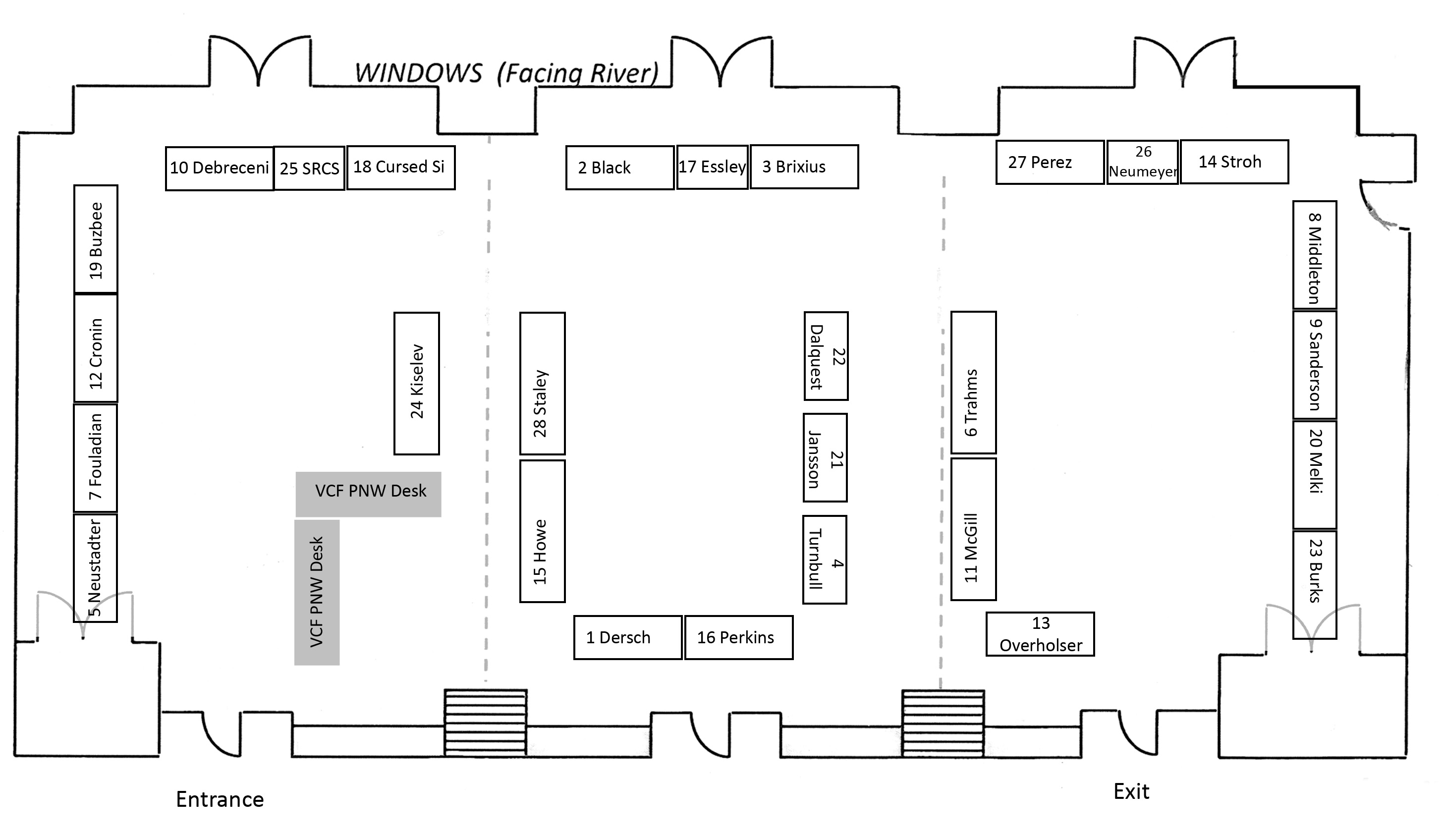
Click the map for a larger version
[1] Josh Dersch, Desktop Computing: Hewlett Packard's First Calculators
Come by and see what personal computing looked like in the late 1960s and early 1970s. On display you will find:
[2] Adrian Black, Adrian's Digital Basement: From Field Found to Function
Adrian Black from YouTube channel Adrian's Digital Basement showcases some of his most memorable restoration projects:
[3] Mike Brixius, Role Playing Game development with RavenWolf Retro Tech (RWRT)
Come see how an RPG for the Commodore 64 which was started in 1984 is now being completed using modern tools. I will be demonstrating how today's development workflow can accelerate 8-bit game creation while still targeting real hardware. A modern PC runs the full toolchain, while a Commodore 64 runs the game, demonstrating how code and assets move from present-day tools to a 40-year-old system. This is not a recreation of the past, but rather an evolution of it.
[4] David Turnbull, The Picocomputer 6502
The Picocomputer 6502 is an open source, modern-retro, gaming computer powered by a real WDC 65C02. USB and Bluetooth LE support means you probably already own the supported accessories such as: keyboard, mouse, gamepads, UART serial, NFC, floppy drives, and flash drives. WiFi enables NTP (time) support and modem emulation so you can call BBSs. Advanced video and sound systems make it easy to squeeze every last drop of performance from the tiny 8-bit processor. Stop by for a hands-on demo!
[5] Eric Neustadter, Exotic Japanese Computers of the 1980s
During the 1980s Japan was - pun intended - an island of personal computing. It was an isolated market bursting with unique computers. Driven primarily by local technology giants Fujitsu, NEC, & Sharp, this continued until the PC standard finally broke through in the early '90s. The designers of these computers were creative and experimental, and this led to some of the most eye-catching industrial designs ever seen in personal computing. In North America we mostly experienced this through BYTE and other magazines. Here's your chance to get hands-on with a few of them at VCFPNW!
[6] Em Trahms, CircleMUD on a MicroVAX
Sit down in front of a variety of serial terminals from the late 1970s and early 1980s. Progress through a fantasy text adventure world with other attendees. Experience the blistering speed of an 11 MHz MicroVAX from the late 80s.
[8] Aaron Middleton, One Maybe Two Retro
Aaron will be displaying a couple of Commodore systems that he has collected since re-entering the retro scene after 30 years. His table includes new 8-bit technologies, new spins on old 8-bit tech, and a replica of his 30 year old BBS system "RAMifications" which is now up and running again after 30 years.
[9] Dan Sanderson, The MEGA65 Personal Computer
The MEGA65 is a modern recreation of the Commodore 65, an unreleased successor to the best-selling single model of home computer of all time, the Commodore 64. Based on internal company documents, unfinished source code, and hardware prototypes liquidated during Commodore's bankruptcy in 1994, the MEGA65 brings the C65 to a modern audience with a faithful reproduction of the injection molded case and keycaps, modern mechanical key switches, both vintage and modern connectivity, up to 640x400 resolution and 23-bit color, 4x SID sound chips and audio DAC, and a built-in 1581-compatible 3-1/2" floppy disk drive. The MEGA65 community continues to develop the FPGA core, KERNAL ROM, and extensive developer documentation, and has released alternate cores for the Commodore PET, VIC-20, C64, and C16, all of which can be installed and selected from an on-board menu.
[10] Mike Debreceni, Amateur Radio and Vintage Computing - Slow Scan Television (SSTV)
See how amateur radio operators worked with vintage computers to exchange Slow Scan Television images. This will include a mix of different systems, ranging from modern Raspberry Pi systems, dedicated SSTV hardware, PC laptops, possibly even a Commodore 64. Send an SSTV selfie back in time to the '80s!
[11] Gregory McGill, Everything TI-99
The TI-99/4 and TI-99/4A are home computers released by Texas Instruments in 1979 and 1981, respectively. Based on TI's own TMS9900 microprocessor originally used in their minicomputers, the TI-99/4 was the first 16-bit home computer, with a 16-bit wide data bus and a 15-bit wide address bus. The architecture of the system is quite unique, including RAM that is accessed through the video processor and ROM expansions that use a low-level interpreted language. My exhibit will be showing the expanded 99/4 system as well as a 99/4A with modern sidecar expansion providing 8mb memory and a multitude of storage options for disk and cartridges. Stop by and check out some modern homebrew as well as the original software releases from the 80s.
[12] Tom Cronin, AA-Powered Portables
A surprising number of portable computers in the 80s and 90s designed to use easy-to-find AA batteries. See and try out a selection of computers from the CP/M based Epson PX-4 through the MS-DOS days and into Windows 3 with the HP Omnibook 425. There's also a trip across the Atlantic, and a journalist's favorite from Radio Shack!
[13] Mark D. Overholser, Networked 8-bit Computers for Gaming, Collaboration and Socializing
A demonstration of 8-bit systems, specifically the C64, the Apple ][ and the Tandy Color Computer (CoCo), networked together with Ethernet or WiFi to interoperate in a game or on the Internet to a system like IRATA.ONLINE.
[14] Steve Stroh, Demonstration of Ham Radio Packet Radio TNCs
Before the Internet was publicly, commercially accessible by just paying a dialup Internet Service Provider, Ham Radio Operators had their own data networks operating on Amateur Radio spectrum. The devices used were called TNCs - Terminal Node Controllers. This exhibit will feature a pair of TNCs actually communicating over radio between two (modern) laptops. Packet Radio operation continues in the 2020s using more modern technology (and speeds) than TNCs.
[15] Jason Howe, VAX-Nation!
Come enjoy an authentic multi-user experience on a VaxServer 3100 and Digital VT-220's. A full suite of compilers and languages are available to use, including VAX Basic, VAX Pascal, DEC Fortran and DEC C. If programming is not your jam, experience the Social Network of the 1980's with VAX Notes! What would a VAX be with out a game or two? Adventure is just a few keystrokes away. (Pen and paper will be available to construct a map as you go).
[16] Jason Perkins, Apple Lisa vs. Xerox Star: Not just a copy
It's often said that Apple "borrowed" a lot of design features from Xerox when they introduced the Lisa in 1983, and the Macintosh in 1984. But, instead of just parroting this common misconception, find out for yourself and compare the Lisa Office System to Xerox GlobalView (AKA Star 2.0) on an Apple Lisa and Xerox 6085 Daybreak. See if you can complete the challenge of "Create a word processing document, and add an illustration"!
[17] Chad Essley, Amiga for Artists
I'll be demonstrating doing some artwork and animaiton using my Amiga 1200 and serial wacom tablet, showing off some examples of it's use professionally in several 90's animations done for Sesame Street as well as a music video and my own experimental film. Visitors can get hands on with TVPaint, DeluxePaint, and Brilliance among other drawing applications.
[18] Cursed Silicon, Compu-Global-Hyper-Mega-Net
The modern web sucks for retro computers. Websites don't load, old computers are super insecure, and a lot of stuff just doesn't work. So we've built a private "retro Internet" where users can attach their machines to play games, use old websites, run old software, and generally just have fun on the web again.
[19] Bill Buzbee, Magic-1 Homebrew CPU
Magic-1 is a homebrew multi-tasking, multi-user minicomputer built from roughly 200 74-series TTL devices using wire-wrap construction. It runs the Minix operating system and has been in continuous operation for more than 20 years. Also appearing will be a newly designed, card-compatible Magic-1 clone built using PCBs.
[20] Katarina Melki, Project IVY - Celebrating Portable Computing
Project IVY is all about restoring wonderful old portable PCs, with an emphasis on IBM ThinkPads. Favorites include the ThinkPad 701C with its folding keyboard, an early 2-in-1 tablet and laptop the ThinkPad 360P, and the very first IBM ThinkPad the 700C. Along with a variety of Palm Top PCs!
[21] Cris Jansson, British Computers from the 80's
Explore two 1980s computers from the UK: the Apricot F1 by ACT and the Z88 by Cambridge Computing. The quirky Apricot F1 ran MS-DOS and the GEM desktop, notably featuring an innovative infrared keyboard and mouse and is one of the first machines to adopt 3.5-inch floppy drives. The Z88 is a small Z80-based notebook originally designed at Sinclair Research, featuring built-in BASIC and a versatile suite of productivity tools.
[22] Bob Dalquest, Puter's Retro World: The Nabu Experience
Discover the Nabu, an ahead-of-its-time Z-80 based personal computing solution from 1982 that pioneered a pre-Internet vision of delivering digital content to homes and schools via the local cable TV network. Though Nabu and the Nabu network saw limited success and soon faded into history, the system recently sparked a retro-computing revival when pallets of unused units surfaced on eBay. Come see a working Nabu setup with Internet Adapter (simulated Cable TV Network interface) running original Nabu "Channels" and explore the incredible preservation efforts of the NABU.CA community, including major contributions from D.J. Sures (family of the original founders) and former NABU senior software engineer Leo Binkowski. For more information check out Nabu.ca.
[23] Joe Burks, OtterX, a new 6502 machine with vintage bones
OtterX began in early 2022 as a initiative to build a community-driven platform for exploring and improving the hardware and firmware foundations of the Commander X16. Today, OtterX carries that spirit forward as an open-source, fully X16-compatible kit computer designed for DIY retro-electronics enthusiasts, all in a compact mini-ITX form factor. Stop by for a hands-on OtterX test-drive and enjoy a showcase of standout games, demos, and utilities created by our vibrant and growing community!
[24] Sergey Kiselev and Michael Kiselev, Keeping Old PC Computers Up and Running
Stop by to see a variety of new retro-style ISA controller cards and a couple of retro IBM PC compatible systems, and discuss how these cards can help you to keep your vintage PC computer running. The exhibit will feature some open source hardware projects, and some closed source, currently manufactured ISA controllers, including floppy disk controllers, hard drive controllers, sounds cards, and network controllers.
[25] Gordon Steemson, Seattle Retro-Computing Society - We exist!
"The best computers glow in the dark!" SRCS is a local user group that meets monthly. Meetings are a combination of show-and-tell, repair clinic, career therapy, and social time. Stop by to say hello and hear why you should hang out with us on the fourth Saturday of the month.
[26] Hayden Neumeyer, When tools became computers
For decades, test equipment was "dumb" hardware: knobs, tubes, and raw signals. But as computers became more complex, the tools used to build them had to evolve. This exhibit captures the turning point where instruments evolved into powerful, specialized computers. From logic analyzers running on high-performance Unix workstations to oscilloscopes hiding x86 PCs behind their knobs, witness the era where the line between the tool and the machine vanished.
[27] Alex Perez, ZuluSCSI and ZuluIDE
Rabbit Hole Computing will be demonstrating and selling ZuluIDE V2, our latest RP2040-based ATAPI CD-ROM emulator, which has simultaneous dual device emulation support. as well as the new ZuluSCSI Ultra Wide OSHW boards. We'll also be selling ZuluSCSI RP2040 Compact boards for sale at VCF show special price of $40, along with the newly-revised ZuluSCSI Blaster boards for $55 each, or $60 with an injection-molded faceplate/bracket.
[28] Troy Staley, PCjr Evolution
PCjr Evolution tells the story of IBM's PCjr beyond its original release, showing how an often-overlooked computer developed a long and unexpectedly creative life. Visitors will see the PCjr as IBM first sold it, with original peripherals, books, and software, then follow its growth through the years as third-party companies like PC Enterprises, Rapport, and Racore introduced expansions, compatibility solutions, and upgrades that kept the system useful well beyond its commercial lifespan. The exhibit concludes with the PCjr as it exists today, transformed by the retro-computing community through modern hardware projects such as JrIDE, accelerator boards, and other inventive modifications that continue to expand the machine's capabilities.
VCF PNW 2026 is sponsored by the Interim Computer Museum (icm.museum), a registered 501(c)(3) charity. Do you like this event? If so, consider a donation to help us continue making this and events like it possible. Your help is greatly appreciated!